
We sailed across the Pacific Ocean from Panama to Australia.
This final leg of 1050 miles was by far the most challenging, treacherous and difficult. This was the homecoming we’ve been so excited about but did not realize that it was going to be in such horrendous conditions.
Our departure was scheduled for Thursday July 20th from Port Vila, Vanuatu. We received the regular skipper’s briefing the night before with information about the start line, route and finish line. This is historically a fast and straight forward passage. Within the fleet however, there was a muttering of concern about the long range forecast. Predict Wind is an app that we all have on our phones and it was starting to indicate that the wind and swell might be threatening for the next week.
The World ARC shared our concern and the next morning decided to delay the start of the leg for an undefined period of time. They told us we could proceed if we chose to. Having already checked out of the country and after an intense huddle on the dock, 13 out of the 18 boats decided to depart ASAP. We wanted to beat the worst of the weather and hoped the forecast was too far out to be entirely accurate.
The boats left as soon as possible with Matilda one of the first to leave the mooring field at 09:30. We had been underway for about 45 mins when we discovered that our auto pilot pin had sheared off. We looked at each other and decided that we could not hand-steer for over 1000 miles (although “that’s what sailors did for eons”) We returned back to the mooring ball and proceeded to tear the boat apart getting out the vice and drill to create a new bolt and pin (drill and tap). The fix was made although, with low expectation, that it would last the entire way and at 11:45 we departed.
The first 3 days were pleasant with some nice sailing and great wind conditions. We did our regular 3 hour night-watch shifts and aside from some sleep deprivation we were doing well.
Meanwhile, the amateur meteorologists in the fleet were getting increasingly concerned about the predicted weather. The anxiety was building during our twice daily SSB calls. The focus was the opening in the reef called Hydrographers Passage and what the conditions would be like when we got there. It is one thing to deal with high wind and swell in the open ocean and quite another navigating through a tight passage in the Great Barrier Reef (GBR).
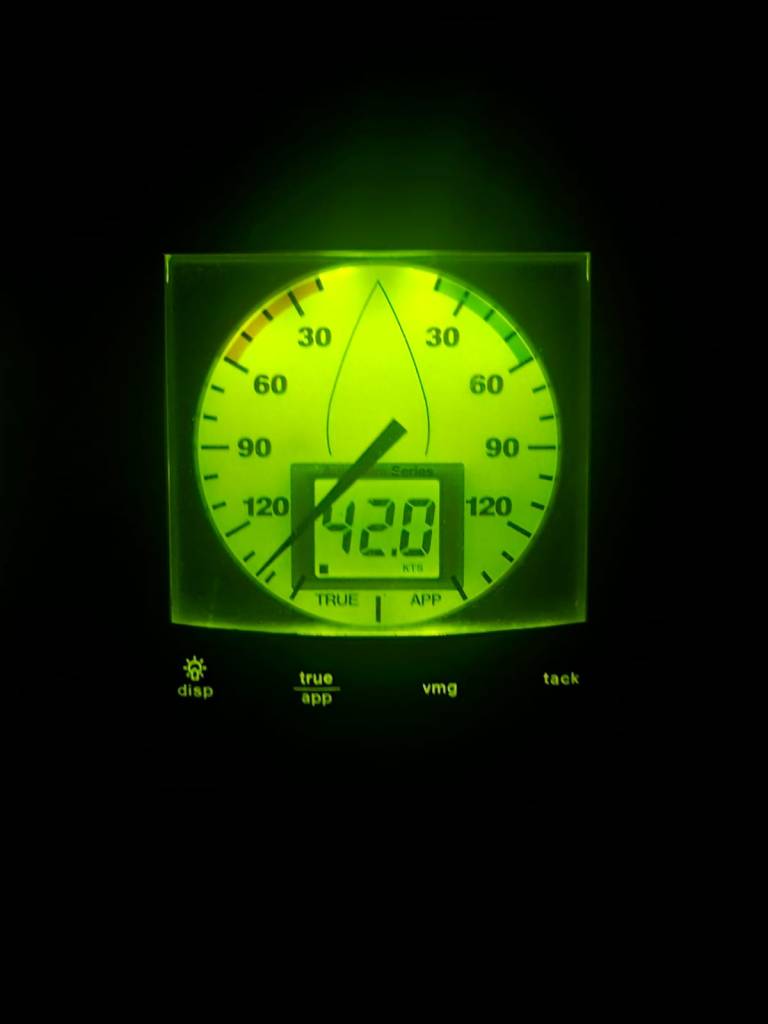
Display showing True Wind Speed
Day 4 and the wind and swell picked up. We endured sustained winds of 35-42 knots and 12 to 16 feet of swell at 8 second intervals. It was becoming very difficult to control the boat and our hydro-vane was not able to keep up. We reefed all the sails until we were virtually “bare-poles” and still we were surfing down the waves at 10-11 knots. The autopilot which had worked for 3 days and which we had been saving for the Pass stopped working. This was not a big surprise but spelled trouble for the Reef Passage.
We were in a full force gale with wind gust as high as 45 knots. The waves hit us from the side and over the bow and even crashed over the stern. Our 3 hour shifts became 1 hour shifts as controlling the boat was really hard. Finally on day 6 we entered The Hydrographers Passage at 15:00 and so relieved to get there in daylight. This Passage is a shipping channel through the reef with many waypoints and turns that need to be navigated. The narrowest part of the passage is about a mile with shipping lanes going in both directions.

Screenshot of Predict Wind showing wind gusts
Our expectation was that once we were inside the reef we would have some protection from the swell. This was not the case. Twenty five miles of this passage was into the wind in a 40 knot gale. We were pounding into the biggest waves we have ever seen.
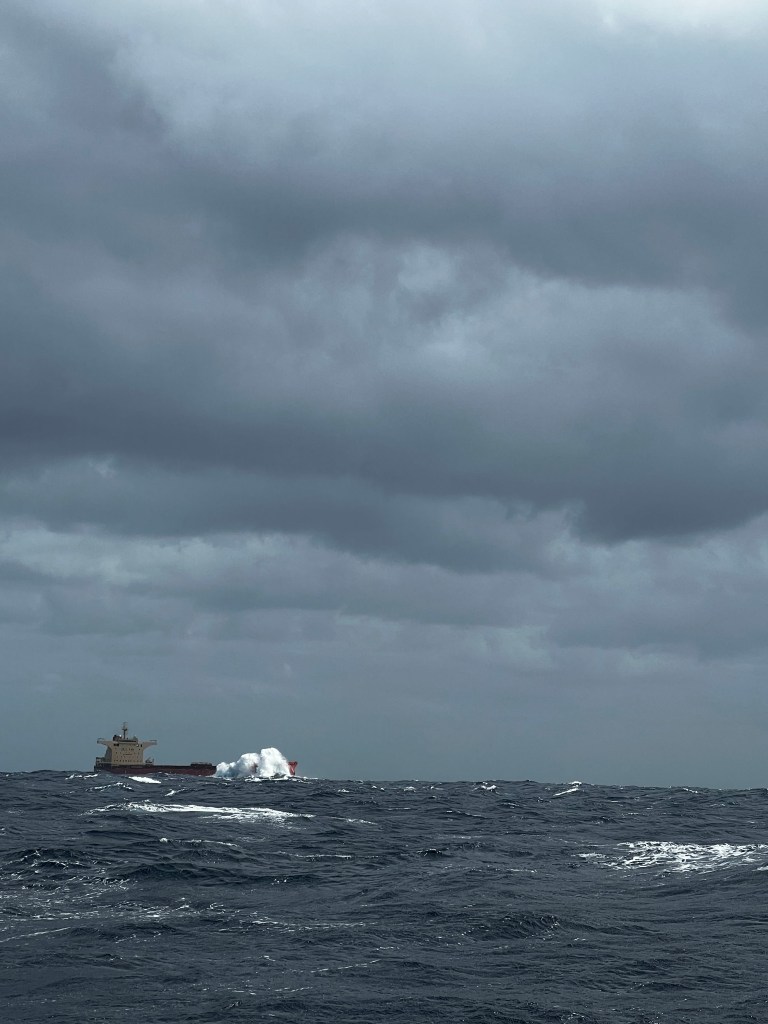
Huge waves breaking over a Freighter
Suddenly, over the radio we heard an emergency distress call from one of our fellow ARC boats. Twelve miles ahead of us, SY Mistral had activated their EPIRB (an emergency satellite alert system.) They had water-ingress and they could not stop the water from coming into their forward cabin. Mistral was sinking and they were trying to pump the water out faster than it was coming in. They have a watertight forward cabin door which when closed was able to partially isolate the leak to that cabin but still the water was coming in. An emergency helicopter was deployed and was overhead to provide an evacuation yet the crew refused to abandon ship. They felt confident that they could get the boat to port with the bilge pump pumping out the water and using buckets to hand bail. A fellow ARC boat Pachamama a huge 62ft catamaran turned around to offer assistance. Pachamama is an Argentinian boat one of the 4 “kid boats” that we have with us. They were calm and reassuring and coordinated the rescue. They shadowed Mistral every step of the way.
Eighteen hours later Mistral limped into port with the entire Mackay Marina and rescue personnel waiting. Mistral was put into slings at the travel lift and the bow lifted up. Chris, the skipper, is a retired British Air Force pilot and Virgin Atlantic pilot. He stayed at the helm the entire time bringing the boat home. Karen his wife and 2 crew members bailed the water for 18hours. The cause of the leak is somewhat unknown but appears to be a ripped-off hatch cover and blocked anchor locker.

SY Mistral coming into Mackay
Matilda pulled into port two hours behind Mistral. We were the 5th boat in and were exhausted. We had not slept for 3 days. We were greeted by Australian authorities and they thoroughly inspected our boat. Australian biosecurity is very strict yet we passed with flying colors.
We are now enjoying the luxury of life in Australia. We are reveling in the availability of fresh food and stores. We have done the tourist thing going to see the wallabies and kangaroos on the beach at 4:30 am although this was done somewhat reluctantly by one member of the Matilda crew
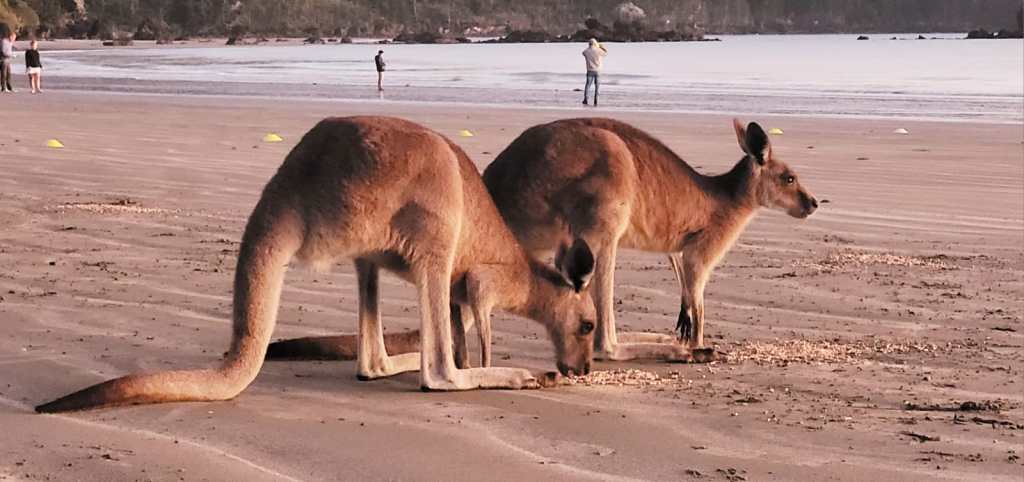
Kangaroos on the beach

Wallaby at sunrise
Matilda needs a lot of repairs after that beating and we are hard at work . With a few more days to recover we will be ready to get back out there and discover the Whitsundays and the Great Barrier Reef.
 Sailboat Matilda
So relieved you made it. You two are quite a team!!
LikeLike
Strength to you ! Making it happen and never a doubt.
LikeLike
You are brave people. We only go thru here once. So live it up. Thanks for sharing your adventure with us.
LikeLike
Wow! What a wild ride that must of been. We’re glad that ultimately you had a “safe” passage. Enjoy land life while you can. Kevin and Stacy
LikeLiked by 1 person
Congratulations !! Well done you two!!! The weather gods were probably tipping their hats to you and Mistral upon your arrival. Just reading about your passage is daunting enough. The experience must be off the charts!!
LikeLike
WOW!
LikeLike
Wow – quite the adventure
That sounds brutal. Glad that you came through it relatively unscathed
LikeLiked by 1 person
Whew. And bravo.
LikeLiked by 1 person
All I can say is WOW!
LikeLiked by 1 person
So happy you made it safely to Australia and can now enjoy some well deserved R&R!
LikeLiked by 1 person
As we say in the Deep South – you done did it. I’m so glad you are all safe and sound. Xoxo. What an adventure you have taken us on.
LikeLike
Bravo brave sailors. Many a night I was awake keeping watch with you. Happy to hear of a safe landing, fresh food and fun. 🦘
LikeLiked by 1 person
Much respect! I’m sure it’s a wonderful feeling arriving ‘home’ in Australia, but it sounds like you earned it for sure.
LikeLike